Two thousand billion yuan. Nearly $295 billion. That is the sum that part of the Chinese state apparatus is preparing to commit, over five years, to build a national network of data centres dedicated to artificial intelligence. The project, reported in June 2026 by Reuters and picked up by the specialist press, is not just one more data centre: it is a mesh of computing hubs spread across the whole territory, interconnected into a single operational grid by 2028, and bound by a rule that says a great deal about the intent — at least 80% of the technology, hardware and software, must be Chinese. In other words: a sovereign wall of compute, erected in direct response to three and a half years of American control over chips. Here is what the plan contains, who holds it up, and what could derail it.
1. What China is putting on the table
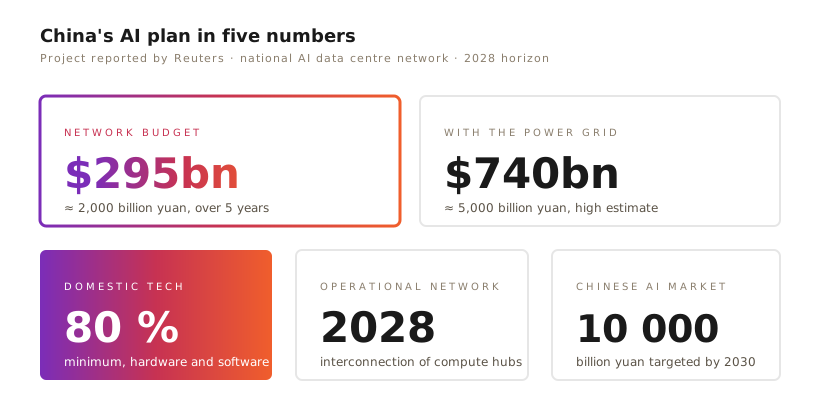
The heart of the project is an envelope of around 2,000 billion yuan, or nearly $295 billion, financed by sovereign debt issuance, very long-term government bonds (maturity of more than ten years), public funds and bank loans. The money is to be used to build and link a national network of data centres designed for training and inference of AI models. The target date for the full network to come into service is 2028.
Sources: Tom's Hardware · Bloomberg / Reuters, June 2026.
The $295 billion figure covers only the computing network itself. When you add the adaptation of the electricity grid needed to power these facilities, reported estimates rise to 5,000 billion yuan, around $740 billion. The project fits into a broader framework: it feeds into the 15th Five-Year Plan (through to 2030) and an official goal of taking China's AI sector to 10,000 billion yuan by the end of the decade. Compute is no longer treated as an infrastructure expense but as a national strategic asset, on a par with water or electricity — it is in fact attached to a programme called "Six Networks", which groups the country's major infrastructures.
2. A state architecture: NDRC, telecom operators, Huawei
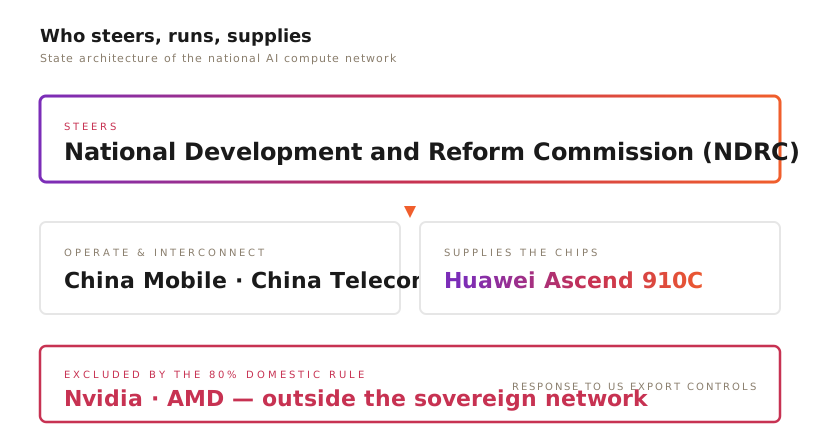
What distinguishes this plan from a private investment is its chain of command. The project is steered by the National Development and Reform Commission (NDRC), China's most powerful economic planning body. It is not private hyperscalers deciding where compute goes: it is the state that draws up the plan, sets the rules and directs the funding.
Sources: Tom's Hardware · heise online, June 2026.
Operation falls to the two state telecom giants, China Mobile and China Telecom, tasked with running most of the facilities and linking them into a coherent computing grid by 2028. Their role is logical: they already own the fibre network, the land holdings and the operating expertise at continental scale. The hardware link, for its part, goes to Huawei, which supplies its Ascend 910C AI chips — the component the manufacturer has pushed into production to offer a domestic alternative to Nvidia accelerators. The overall logic is vertical: the state plans, the public operators build, the national champion equips.
3. The 80% rule: Nvidia and AMD locked out
The clause with the heaviest consequences is not the amount, it is the threshold. The plan requires that at least 80% of the technology deployed — chips included — come from Chinese suppliers. On a network of this size, financed with public money and steered by the NDRC, this rule amounts to closing the door on American accelerators. Nvidia and AMD, already restricted in exports by Washington, now find themselves excluded by demand itself.
To understand why this clause is credible and not wishful thinking, it must be read alongside the news on models. In April 2026, the DeepSeek lab released a frontier open-source model trained without a single Nvidia chip, on Huawei hardware — we analysed it in DeepSeek V4: China no longer needs Nvidia. The infrastructure plan and the software shift answer each other: one provides the sovereign demand, the other proves that the domestic stack can produce a top-tier model.
4. The blind spot: the "sovereign" chip still depends on foreign supply
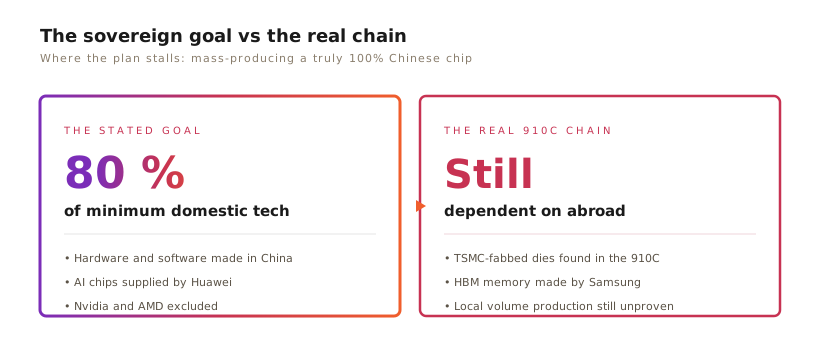
This is where the "100% Chinese" narrative cracks. The chip that is to equip this network, the Ascend 910C, is not yet as domestic as the target demands. Analyses reported by the specialist press mention dies fabricated at TSMC — the Taiwanese foundry — found inside Ascend cards, and HBM memory made by Samsung. If these findings reflect large-scale production practice, they mean that Huawei's supply chain still depends on components that official channels cannot reliably deliver.
Source: Tom's Hardware, June 2026.
The real bottleneck is therefore not money — China can mobilise $295 billion — nor chip design, which Huawei masters. It is the ability to produce a truly 100% Chinese chip in volume, at a pace sufficient to fill a national network by 2028. Leading-edge domestic foundry capacity remains the hardest stage to bring in-house: it is what will tell us whether the plan keeps its schedule or runs into the limits of local production.
5. Energy, the ceiling that money cannot buy
The second wall is physical. A national network of AI data centres consumes electricity on a scale counted in gigawatts. That is precisely why the plan's high estimate climbs to $740 billion once the adaptation of the electricity grid is included: computing infrastructure is worth nothing without the energy infrastructure that feeds it. China starts with an advantage — a massive power fleet, partly nuclear and renewable, and a state able to subsidise industrial electricity. But the energy constraint remains the real ceiling for any compute project of this size, on both sides of the Pacific.
It is the same wall that American hyperscalers are hitting. For a reading of the physical economics behind the cost of compute, see our article The real energy cost of AI in 2026. And to place this plan in the global infrastructure race, The war of AI infrastructures: USA, China, Europe.
6. What it changes for a European company
At first sight, a Chinese infrastructure plan does not concern the head of a French mid-sized company. That is a misreading. Three effects trickle down to your spreadsheet.
One: pressure on compute prices. The more China builds sovereign capacity and runs competitive models on its own stack, the more downward pressure on model costs intensifies worldwide. Chinese open-source models, deployable with a European host, become a credible and cheap alternative for part of your workloads. The cost of an agent in production is no longer set by an American duopoly.
Two: sovereignty turns into a concrete argument. The European debate on AI sovereignty is leaving the realm of rhetoric. If China can build an autonomous stack, the question "why not us" becomes legitimate on the European side, and the continent's hosts (Scaleway, OVHcloud, Outscale) have a wide-open road to offer sovereign deployments. For an SMB, this means there will be more and more options for running AI under a European contract, compliant with the GDPR and the AI Act, without depending on a single supplier.
Three: geopolitical risk enters the technical decision. Choosing a model now means choosing an infrastructure camp. Deploying a Chinese model, even self-hosted in Europe, raises questions of compliance, corpus bias and acceptability depending on your sector. The "which model" decision is no longer just an engineers' matter: it deserves a decision at executive committee level.
7. Areas of vigilance
A plan, not yet a decree. At the date of this article, this is a project reported by the press, not a programme officially promulgated in all its details. The amount, the timetable and the 80% threshold are parameters liable to change between intention and implementation. To be treated as a trajectory, not as a fact set in stone.
The pace of chip production is the major unknown. The whole 2028 timetable rests on the Chinese industry's ability to manufacture domestic accelerators in volume. It is the least controlled stage, the one where foundry bottlenecks can push back the entire project.
The opacity of the figures. The amounts circulate via leaks and agency reports, with no public budget detailed line by line. The order of magnitude is solid and corroborated by several sources; the precise breakdown is not.
Residual dependence can backfire. As long as the flagship chip incorporates foreign components, a tightening of controls on HBM memory or on access to foundries could weigh on the pace. The autonomy being sought is not yet the autonomy achieved.
8. Our reading
This plan is not a prestige announcement. It is the infrastructural implementation of a doctrine: making compute a national asset, planned like an electricity grid, financed by state debt, closed to foreign suppliers. What is new is not that China is investing in AI — everyone is. It is that it does so in directed mode, with a sovereignty threshold written black on white and a short deadline. American export control aimed to slow this trajectory; it accelerated it by making it a priority.
What remains is the gap between intention and execution. The plan is credible on money, credible on political will, credible on the chain of players. It is less so on the one point that really matters in the end: producing, en masse and without a foreign crutch, the chips that will fill this network. It is on that precise point that we will have to judge, in twelve to eighteen months, whether China has built a sovereign wall of compute or a network whose central component remains, for now, half imported.
Further reading: DeepSeek V4: China no longer needs Nvidia, Beijing, 14-15 May 2026: the end of technological containment, and The war of AI infrastructures: USA, China, Europe.