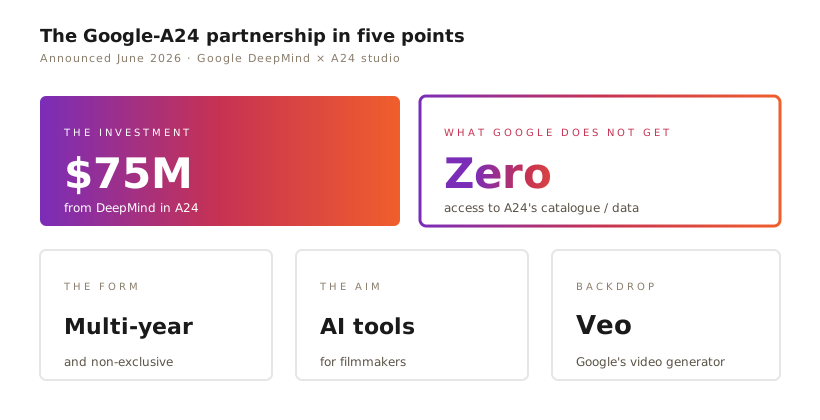
Google and the independent studio A24 have sealed an artificial intelligence research partnership. Its DeepMind division is investing 75 million dollars to co-develop, with the studio's directors, AI tools for making films. Several headlines summed it up as "Google teams up with A24 to train its AIs" — a misleading formula. According to the trade press, the agreement gives Google neither A24's catalogue nor its data. This nuance is no detail: it entirely changes how we read what Hollywood is negotiating with AI.
1. What has been signed
The pact is multi-year and non-exclusive: A24 remains free to work with other AI players, and DeepMind with other studios. In practical terms, DeepMind researchers work directly with A24's production teams to build tools covering the whole chain, from pre-production to distribution. DeepMind was already collaborating with individual filmmakers, such as Darren Aronofsky; this is, however, its first known partnership with a full studio.
Sources: The Hollywood Reporter · Variety, June 2026.
2. The nuance that changes everything: no catalogue handed over
This is the heart of the matter, and it is where the simplifying headlines mislead. The sensitive point of generative AI in cinema is training models on protected works — the subject of every conflict with rights holders. Here, however, the agreement does not provide for handing A24's film library to Google. This is not a studio selling off its heritage to feed a model; it is a studio co-developing tools while keeping control of its content.
3. A model different from the other studios'
Most rapprochements between Hollywood and the AI giants revolve around access to content: catalogue licences to train models, synthetic dubbing agreements, rights assignments. The Google-A24 pact takes the opposite angle: the value exchanged is tools and R&D, not data. For a studio, it is a way of entering the AI era without liquidating the asset that makes it valuable — its intellectual property.
It is exactly the shift in value we see everywhere: the machine manufactures, but what gets monetised is the work, the artistic direction and the relationship with the audience. The same reasoning as for the 100% AI animated series based on a Chinese classic, except that A24 has chosen to keep its content out of the model.
4. Areas of vigilance
"Non-exclusive" and "no data access" are commitments to monitor over time. Partnerships evolve; what is excluded at the outset can be renegotiated. Vigilance concerns future amendments, not the announcement.
The tools remain to be seen. Co-developing AI tools for filmmakers is a promise; their real usefulness in production will be judged on the films, not on the press release.
The social question remains. Even without handing over a catalogue, the arrival of AI tools in production workflows raises again the question of cinema's technical trades. A studio that commits must support that transition, not hide it behind the talk of a tool that "helps the artist".
5. Our reading
This partnership is a textbook case of critical reading. The raw fact — "Google invests $75M in A24" — is correct. The lazy interpretation — "to hoover up its catalogue" — is false. And it is precisely the difference between the two that constitutes the useful information: a studio can now adopt AI as a tool, under conditions, without giving up control of what makes it valuable.
For an executive, the transposition is direct. Working with an AI provider does not oblige you to hand over your data. The right question in 2026 is not "should we use AI" but "on what terms": what you give up, what you keep, and what you remain free to renegotiate. The devil, as always, is in the contract.
To go further: in the United Kingdom, a case won thanks to an AI lawyer, and China's 295 billion AI infrastructure plan.